HEADLINE
Venezuela Grapples with Rising Death Toll After Devastating Twin Earthquakes
OPENING HOOK
The grim reality of Venezuela's recent twin earthquakes continues to unfold, with official figures confirming a staggering death toll that now approaches 3,000. As international rescue teams begin to wind down their intensive search for survivors, the focus shifts to the immense challenge of recovery and supporting the thousands left homeless and displaced.
WHAT HAPPENED
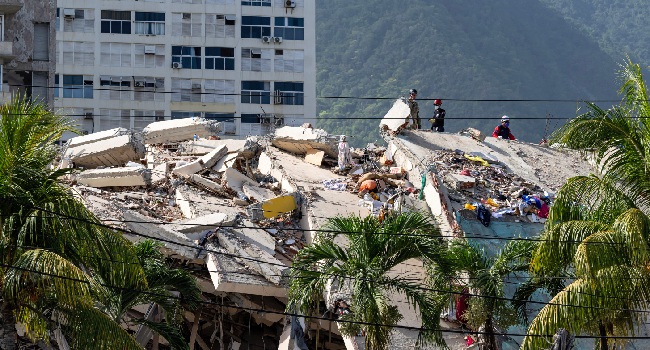
Official figures released on Saturday indicated that the death toll from Venezuela's devastating twin earthquakes, which struck on June 24, has surged to 2,954. This represents a significant increase of over 300 fatalities from the previous day's count. The catastrophic events have left thousands without homes, forced into makeshift street shelters and relief camps, while tens of thousands more remain unaccounted for. This disaster, considered one of Latin America's worst earthquake tragedies, hit the coastal region of La Guaira, just north of the capital city, Caracas, with particular severity, where numerous residential buildings were completely flattened by the powerful tremors.
WHO ARE THE KEY PLAYERS
The immediate key players include the **Government of Venezuela**, which is coordinating the national response, emergency services, and providing aid to affected citizens. **International rescue teams** from various countries, comprising specialists in urban search and rescue (USAR), have been crucial in the initial phase, sifting through rubble for survivors. The **affected citizens** of Venezuela, particularly those in La Guaira and Caracas, are central to this unfolding tragedy, grappling with loss, displacement, and the arduous task of rebuilding their lives. Various **international humanitarian organizations** are also expected to play a significant role in long-term relief and reconstruction efforts.
UNDERSTANDING THE LOCATION
**Venezuela**, officially the Bolivarian Republic of Venezuela, is a country on the northern coast of South America. It is known for its diverse natural landscapes, including the Andes Mountains, Caribbean coast, and Amazon basin. The recent disaster struck hardest in **La Guaira**, a coastal state situated directly north of the capital, **Caracas**. La Guaira is a vital port city and a popular tourist destination, making its infrastructure particularly vulnerable to seismic activity. Caracas, as the economic and political heart of the nation, also experienced significant impact due to its proximity and the density of its urban areas. The coastal nature of La Guaira specifically amplifies the risks during earthquakes, including potential for liquefaction and tsunami threats, though the primary damage here appears to be from ground shaking.
BACKGROUND AND CONTEXT
Venezuela lies within an active seismic zone, making it susceptible to earthquakes due to its location near the Caribbean and South American tectonic plate boundary. Historically, the region has experienced significant seismic events, though not always of this magnitude or with such a devastating impact. Major earthquakes have periodically afflicted Latin America, leading to substantial loss of life and infrastructure, such as the 1970 Ancash earthquake in Peru or the 2010 Haiti earthquake. These past events underscore the persistent vulnerability of densely populated areas in seismically active regions, highlighting the critical need for stringent building codes and effective disaster preparedness strategies.
EXPLAINING IMPORTANT REFERENCES
The term "**twin earthquakes**" refers to two significant seismic events occurring relatively close in time and geographical proximity, rather than a main shock followed by typical aftershocks. This can lead to compounded damage and increased instability of already compromised structures. A "**7.2 magnitude**" earthquake, as reported for one of the tremors, indicates a very powerful event on the Richter scale. To put it simply in Nigerian terms, a 7.2 magnitude earthquake releases energy equivalent to many atomic bombs and is capable of causing widespread, severe damage over a large area, flattening well-built structures and causing extensive landslides. When such a strong quake hits a "**coastal area**" like La Guaira, it poses additional risks beyond structural collapse, including potential for liquefaction (where saturated soil loses strength and behaves like a liquid) and, in some cases, tsunamis, though the latter was not the primary devastation reported here.
IMPACT ANALYSIS
The immediate impact of these twin earthquakes is catastrophic, primarily measured by the tragic loss of nearly 3,000 lives and the disappearance of tens of thousands more, leaving families in agonizing suspense. The destruction of countless residential complexes has created a massive humanitarian crisis, with thousands rendered homeless and dependent on emergency shelters and aid. This widespread displacement places immense strain on local resources and public services. Economically, the damage to infrastructure, including homes, roads, and utilities, will necessitate a monumental and costly reconstruction effort, potentially setting back development in affected regions for years. Psychologically, the trauma endured by survivors and those who lost loved ones will have long-lasting effects, requiring substantial mental health support. The disaster also highlights potential vulnerabilities in building codes and urban planning in high-risk seismic zones.
WHAT HAPPENS NEXT
In the immediate future, the focus will shift from active search and rescue to recovery operations, including the difficult task of identifying remains and clearing vast amounts of rubble. Humanitarian aid, both domestic and international, will be critical to sustain the displaced populations with food, water, medical care, and temporary shelter. In the medium to long term, Venezuela faces the monumental challenge of reconstruction. This will involve rebuilding homes and infrastructure, which requires significant financial investment and coordinated effort. International assistance, potentially through multilateral organizations, will be crucial. Furthermore, the disaster will likely prompt a re-evaluation of building codes, urban development plans, and national disaster preparedness strategies to better mitigate the impact of future seismic events in this active region.
HERO PERSPECTIVE
At Leverage On Heroes Media, our editorial stance on the Venezuelan earthquake disaster is one of profound empathy and a call for sustained, collaborative action. While the immediate search for survivors winds down, the real heroism now rests with the resilience of the Venezuelan people and the unwavering commitment of the global community to support their long road to recovery. This tragedy underscores the universal vulnerability to natural forces and the critical importance of robust infrastructure, early warning systems, and transparent, efficient disaster management. We believe that true leverage lies in collective human solidarity, ensuring that the victims are not forgotten and that lessons learned lead to stronger, more prepared communities worldwide. This is not just a Venezuelan crisis; it is a global humanitarian challenge that demands our continued attention and support.
CLOSING
The shadow of the twin earthquakes continues to lengthen over Venezuela, with the rising death toll serving as a stark reminder of nature's formidable power. As the world witnesses the scale of this human tragedy, the coming months and years will test the resilience of a nation and the resolve of the international community to provide the necessary support for recovery and rebuilding.