
HEADLINE
Cosmic Clues: How Deuterium in Comets Unlocks Secrets of Our Solar System's Past
OPENING HOOK
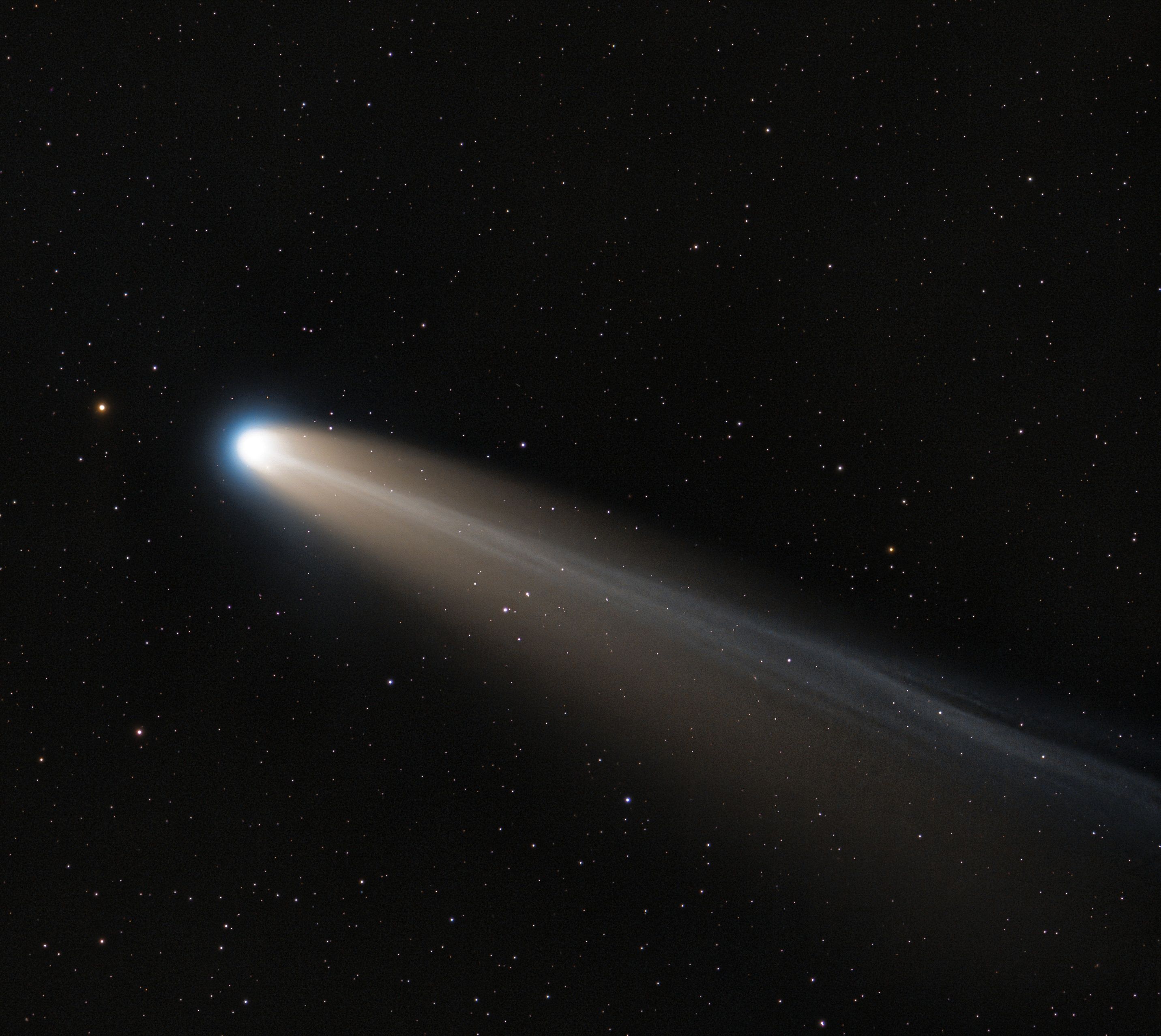
From ancient omens to modern scientific marvels, comets have captivated humanity for millennia. These celestial wanderers, once feared or revered as portents of destiny, are now understood as vital time capsules, carrying within them the primordial ingredients of our solar system. Today, scientific scrutiny of their composition, particularly the presence of deuterium, is revealing fascinating 'tales' about the very beginnings of our cosmic neighbourhood.
WHAT HAPPENED
Astronomers are increasingly focusing on the isotopic signature of water found in comets – specifically, the ratio of deuterium to hydrogen. Deuterium, often called 'heavy hydrogen,' is an isotope of hydrogen with an extra neutron. The specific ratio of deuterium to ordinary hydrogen (D/H ratio) in a comet’s water ice can act as a fingerprint, offering crucial clues about where and when that water formed in the early solar system. Recent studies of various comets have shown a wide range of D/H ratios, indicating different origins and evolutionary paths for these icy bodies, and providing new perspectives on the source of water on planets like Earth.
WHO ARE THE KEY PLAYERS
The study of comets and their deuterium content involves a global network of scientific institutions and individual researchers. Key players include astronomers and planetary scientists from major space agencies like the National Aeronautics and Space Administration (NASA) in the United States and the European Space Agency (ESA), which have designed and executed missions such as Rosetta and its Philae lander, providing unprecedented close-up data from a comet. Universities and research institutes worldwide, from the California Institute of Technology (Caltech) to the Max Planck Institute for Solar System Research, also contribute significantly through telescopic observations, laboratory analysis, and theoretical modeling. These experts are the ones deciphering the complex chemical messages carried by these cosmic iceballs.
UNDERSTANDING THE LOCATION
Comets originate primarily from two vast, cold regions at the outer edges of our solar system: the Kuiper Belt and the Oort Cloud. The Kuiper Belt is a doughnut-shaped region beyond Neptune's orbit, home to countless icy bodies. Further out, the Oort Cloud is a spherical shell of icy objects stretching almost a light-year from the Sun. Gravitational perturbations, often from passing stars, can dislodge these objects, sending them on long, elliptical journeys into the inner solar system, where they become visible as they warm up and release gas and dust, forming their characteristic tails. It is during these brief visits that scientists get a chance to study their ancient compositions.
BACKGROUND AND CONTEXT
For centuries, comets were observed with a mixture of awe and trepidation. Ancient cultures across Africa, Asia, and Europe often interpreted their appearances as divine messages or harbingers of significant events – be it famine, war, or the birth of a king. This perception persisted until the scientific revolution, when figures like Isaac Newton began to understand their orbits and physical properties. Modern astronomy has transformed our understanding, revealing comets as pristine remnants from the formation of our solar system, roughly 4.6 billion years ago. Their icy nuclei contain a mix of water ice, dust, and frozen gases, essentially a 'fossil record' of the conditions present when the Sun and planets first coalesced. The specific D/H ratio in water is a powerful tool because it is established during the very cold conditions of star and planet formation and largely preserved over cosmic timescales.
EXPLAINING IMPORTANT REFERENCES
At the heart of this research is **deuterium**, an isotope of hydrogen. Isotopes are variants of a particular chemical element which have the same number of protons in each atom, but different numbers of neutrons. While a regular hydrogen atom has one proton and no neutrons, a deuterium atom has one proton and one neutron, making it 'heavier.' This slight mass difference is crucial because the D/H ratio in water molecules can vary depending on the temperature and environment where the water formed. A higher D/H ratio generally indicates formation in very cold, primordial conditions. By comparing the D/H ratio in cometary water with that found in Earth's oceans, scientists can evaluate if comets were the primary delivery mechanism for Earth's water, a fundamental ingredient for life. Early results from missions like ESA's Rosetta, which studied Comet 67P/Churyumov-Gerasimenko, showed a D/H ratio significantly different from Earth's, suggesting that while comets contributed, they might not be the sole source of our planet's water.
IMPACT ANALYSIS
Understanding the deuterium content in comets has profound implications for our grasp of solar system evolution and the origin of life. If comets delivered a significant portion of Earth's water, it suggests that water, and potentially the building blocks of life, could be common throughout the galaxy. Conversely, if comets were not the primary source, then other mechanisms, such as water-rich asteroids or even indigenous formation within Earth's early mantle, become more prominent theories. This research helps refine models of planet formation, offering insights into the distribution of volatile elements (like water) in protoplanetary disks – the swirling gas and dust clouds from which planets are born. It also guides future space missions, pointing to specific types of comets or asteroids that might hold the most valuable clues.
WHAT HAPPENS NEXT
The scientific journey to fully understand comets and their role in cosmic history is far from over. Future missions are being planned to visit more comets and even return samples to Earth for detailed laboratory analysis, offering even more precise measurements of their isotopic compositions. Advanced telescopes, both ground-based and space-based, will continue to observe comets as they approach the Sun, collecting spectroscopic data that reveals their chemical makeup. Continued research will focus on building more comprehensive models that integrate data from diverse comets, meteorites, and planetary atmospheres to paint a clearer picture of the processes that led to the water-rich Earth we inhabit today. The goal is to resolve the lingering questions about where our planet's life-sustaining water truly came from.
HERO PERSPECTIVE
Leverage On Heroes Media believes that the relentless human pursuit of knowledge, even into the cold, silent depths of space, is a testament to our enduring spirit of inquiry. Unraveling the 'tales' told by deuterium in comets isn't just about understanding celestial ice; it's about understanding our own origins. It's about connecting the distant past of the solar system to the very water that flows through our rivers and sustains life on Earth, reminding us that we are all, in a profound sense, products of the cosmos. This scientific quest embodies the heroism of curiosity, pushing the boundaries of what is known to illuminate our place in the grand tapestry of the universe.
CLOSING
The humble comet, once a harbinger of myth, now stands as a crucial witness to cosmic history, its icy heart whispering secrets of creation, patiently waiting for humanity to listen and learn.