
HEADLINE
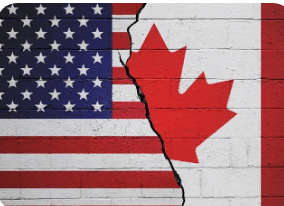
US-Canada Trade Tensions Escalate: President Trump Imposes Sweeping 50% Tariffs on Canadian Exports
OPENING HOOK
In a move set to significantly reshape North American economic relations, the United States has launched a substantial new front in its trade policy, targeting its northern neighbour, Canada, with steep import duties. This development signals a critical juncture in the long-standing economic partnership between the two nations.
WHAT HAPPENED
President Donald J. Trump of the United States has initiated a policy to impose a 50 per cent tariff on a wide array of Canadian exports. This decision marks a significant intensification of the ongoing trade friction between Washington and Ottawa, potentially disrupting supply chains and economic stability across the continent.
WHO ARE THE KEY PLAYERS
**Donald J. Trump:** As the incumbent President of the United States, Mr. Trump is the chief executive and commander-in-chief, holding significant power over foreign policy and trade decisions. His administration's 'America First' approach often prioritises domestic industries through protectionist measures like tariffs.
**Mark Carney:** The incumbent Prime Minister of Canada, Mr. Carney, leads the Canadian government and is responsible for responding to such economic pressures. His administration will need to navigate the implications of these tariffs and formulate Canada's response.
**The United States:** A global economic powerhouse and Canada's largest trading partner, the U.S. wields immense influence over international trade. Its actions directly impact global markets and bilateral relations.
**Canada:** A G7 nation with a highly developed economy, Canada relies heavily on trade, particularly with the United States. Its economy is deeply integrated with that of its southern neighbour, making it particularly vulnerable to U.S. trade policies.
UNDERSTANDING THE LOCATION
The United States and Canada share the world's longest undefended border, facilitating extensive cross-border trade and cultural exchange. This geographical proximity has historically fostered a robust economic partnership, with goods, services, and people moving freely between the two nations. The current actions threaten to undermine this long-standing relationship, impacting communities and industries on both sides of the border that have grown interdependent over decades.
BACKGROUND AND CONTEXT
Trade relations between the U.S. and Canada have historically been governed by agreements designed to promote free trade, most notably the North American Free Trade Agreement (NAFTA), which was later renegotiated into the United States-Mexico-Canada Agreement (USMCA). Despite these frameworks, periodic disputes over specific industries, such as lumber, dairy, and steel, have arisen. President Trump's administration has consistently advocated for what it perceives as 'fairer' trade terms, often employing tariffs as a tool to achieve these objectives, leading to what some analysts describe as 'trade wars' with various partners, including China and the European Union. This latest move against Canada is a continuation of this protectionist stance, aimed at reducing trade deficits and boosting domestic production.
EXPLAINING IMPORTANT REFERENCES
**Tariff:** In simple terms, a tariff is a tax imposed by a government on goods and services imported from another country. Think of it like an extra charge added to the price of foreign goods when they enter a market, making them more expensive for local buyers and less competitive than goods produced domestically. A 50% tariff means that for every 100 Naira worth of Canadian goods, an additional 50 Naira tax is applied when it enters the U.S.
**Trade War:** This refers to a situation where countries try to hurt each other's trade by imposing tariffs or quotas on each other's imports. It's like an economic battle where each side uses trade restrictions as weapons, often leading to higher prices for consumers and reduced economic growth for all involved.
**Canadian Exports:** These are goods and services produced in Canada and sold to other countries, primarily the United States. They include a wide range of products from natural resources like oil and timber to manufactured goods and agricultural products. Tariffs on these exports make them less attractive to U.S. buyers, potentially hurting Canadian producers.
IMPACT ANALYSIS
The imposition of a 50% tariff will have significant repercussions. For Canada, key export sectors could face substantial losses, potentially leading to job cuts and reduced economic output. Businesses that rely on the U.S. market for a large portion of their sales will struggle to compete, potentially leading to closures. Consumers in the United States may also feel the pinch through higher prices for goods that traditionally came from Canada, as the cost of the tariff is often passed down. Beyond direct economic impact, this move strains diplomatic relations between two historically close allies, potentially affecting cooperation on other crucial matters like continental security and environmental initiatives. It could also trigger retaliatory tariffs from Canada, further escalating the trade dispute and creating uncertainty for global markets.
WHAT HAPPENS NEXT
Canada is expected to respond to these tariffs, possibly through retaliatory measures on U.S. imports or by seeking avenues for negotiation. The global trade community will closely watch these developments, as an escalating trade war between two major economies could have ripple effects on international supply chains and commodity prices. Businesses on both sides of the border will be forced to re-evaluate their strategies, seeking new markets or adjusting their production to mitigate the impact. The coming weeks will likely see intense diplomatic activity as both nations attempt to navigate this challenging economic landscape.
HERO PERSPECTIVE
Leverage On Heroes Media believes that while nations have the right to protect their economic interests, such aggressive trade measures, especially between long-standing allies, often create more losers than winners. We advocate for dialogue and diplomacy as the primary tools for resolving trade disputes, ensuring that the economic well-being of ordinary citizens and the stability of global markets are prioritised over protectionist impulses. Our focus remains on how these decisions impact the everyday Nigerian, understanding that disruptions in major international trade flows can eventually lead to increased costs for imported goods or reduced investment opportunities even here at home.
CLOSING
The decision by President Trump to impose 50% tariffs on Canadian exports marks a pivotal moment in US-Canada relations, threatening to unravel decades of economic integration. The true measure of this policy will be seen in the coming months as both nations grapple with its economic and diplomatic fallout.