
HEADLINE
Tehran Gripped by Massive Funeral Procession for Iran's Supreme Leader, Ayatollah Ali Khamenei
OPENING HOOK
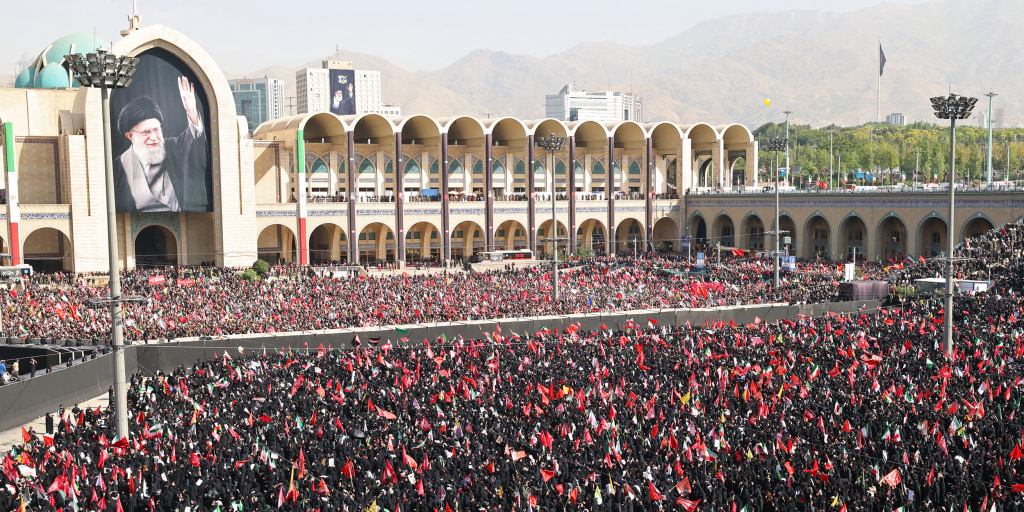
The streets of Tehran have transformed into a sea of black, as an unprecedented multitude of Iranian citizens gathers to bid farewell to their late spiritual and political leader, Ayatollah Ali Khamenei. This monumental funeral procession, stretching for hours, underscores a pivotal moment for the Islamic Republic, drawing global attention to the nation's steadfast traditions and its future trajectory.
WHAT HAPPENED
A funeral procession for Iran's late Supreme Leader, Ayatollah Ali Khamenei, is currently underway in Tehran, drawing hundreds of thousands of mourners. The solemn event, which commenced earlier today, is anticipated to last between 10 to 12 hours, with vast crowds filling major boulevards and squares, reflecting the profound impact of his leadership on the nation.
WHO ARE THE KEY PLAYERS
The central figure in this event is the **late Ayatollah Ali Khamenei**, who served as the Supreme Leader of Iran since 1989. As the second Supreme Leader following the Islamic Revolution, he held the highest religious and political authority in the country, overseeing all major state policies and military decisions. His passing marks a significant transition. The **Iranian government** and its various institutions, including the Islamic Revolutionary Guard Corps (IRGC) and the Basij militia, are instrumental in organizing and securing this massive public gathering. The **Iranian people**, comprising millions of citizens from diverse backgrounds, are the primary participants, expressing national mourning and solidarity. Globally, various **international observers and governments** are closely monitoring the event for insights into Iran's immediate and long-term political stability and foreign policy directions.
UNDERSTANDING THE LOCATION
**Tehran** is the bustling capital city of Iran, located in the north-central part of the country. It is not only Iran's largest city but also its political, economic, and cultural heart. As the seat of the Iranian government and the spiritual center for many, major national events like this funeral procession are typically held here. Its expansive boulevards and public squares, such as Azadi Square and Enghelab Square, are often chosen for large-scale public demonstrations and ceremonies, making it a fitting location for a gathering of this magnitude.
BACKGROUND AND CONTEXT
Ayatollah Ali Khamenei's leadership succeeded that of Ayatollah Ruhollah Khomeini, the founder of the Islamic Republic, in a period of immense national and international challenges. His three decades at the helm saw Iran navigate complex geopolitical landscapes, including regional conflicts, international sanctions, and significant internal social and political shifts. The Supreme Leader's role is unique, combining religious jurisprudence with ultimate state authority, making his passing a moment of both religious observance and political succession. Funerals for such revered figures in Iran are traditionally grand affairs, serving as powerful demonstrations of national unity and popular allegiance to the Islamic system, often attracting millions, much like the funeral of Ayatollah Khomeini in 1989.
EXPLAINING IMPORTANT REFERENCES
In the context of Iran, the **Supreme Leader** is the highest political and religious authority, holding more power than the President. This position, known in Persian as *Rahbar*, is established by the Iranian constitution and is responsible for determining the general policies of the Islamic Republic, acting as commander-in-chief of the armed forces, and appointing key officials. The **funeral procession** is not merely a burial rite but a significant national ceremony, a public display of mourning and respect, often used to reinforce national cohesion and the legitimacy of the state's leadership. The sheer scale, involving “hundreds of thousands” of mourners, is a testament to the cultural and political significance attributed to the departed leader.
IMPACT ANALYSIS
The passing of Ayatollah Ali Khamenei and the ensuing funeral procession have immediate and far-reaching implications. Domestically, it signals a period of political transition, with the **Assembly of Experts** — a body of high-ranking clerics — tasked with selecting his successor. This process, while constitutionally defined, often involves intense internal deliberations and power dynamics. The massive turnout at the funeral could be interpreted as a demonstration of public support for the existing system and a call for stability during this critical juncture. Regionally, Iran's foreign policy, particularly concerning its engagement with Middle Eastern states and its nuclear program, will be closely watched for any shifts under new leadership. Globally, major powers will be assessing how the succession impacts international relations and efforts to de-escalate tensions in the Gulf.
WHAT HAPPENS NEXT
The immediate focus will be on the selection of the next Supreme Leader by the **Assembly of Experts**. This body will convene to deliberate and choose a new leader from among qualified clerics. The process could be swift or protracted, depending on internal consensus. During this interim, key government functions will continue, but the nation will be in a state of heightened anticipation. Beyond the succession, observers will be keen to see if the new leadership signals any significant changes in Iran's domestic policies, economic reforms (especially concerning sanctions), or its regional and international postures. The stability of the transition will be a critical indicator for both internal and external stakeholders.
HERO PERSPECTIVE
Leverage On Heroes Media views this moment as a crucial test of institutional resilience and national identity for Iran. The immense outpouring of public emotion, while a traditional aspect of such transitions, also highlights the profound connection between the Iranian state and its citizenry. Our editorial angle emphasizes the importance of a peaceful and orderly succession for regional stability and global security. We will continue to provide balanced analysis, focusing on how this transition impacts not only the Iranian people but also the broader geopolitical landscape, stressing the need for calm and constructive engagement during periods of significant leadership change.
CLOSING
As the funeral procession continues to wind its way through Tehran, the world watches with bated breath. The coming days and weeks will undoubtedly define the immediate future of Iran, underscoring the enduring power of tradition and the complexities of political succession in a nation with profound regional and international influence. Leverage On Heroes Media remains committed to delivering accurate and insightful reporting on these developing events.