
HEADLINE
How to use ChatGPT's new, more natural Voice Mode for conversations
OPENING HOOK
Conversing with an artificial intelligence assistant has historically felt stiff and mechanical, but recent software updates have dramatically reduced that awkwardness by introducing human-like pacing and emotional inflection.
WHAT HAPPENED
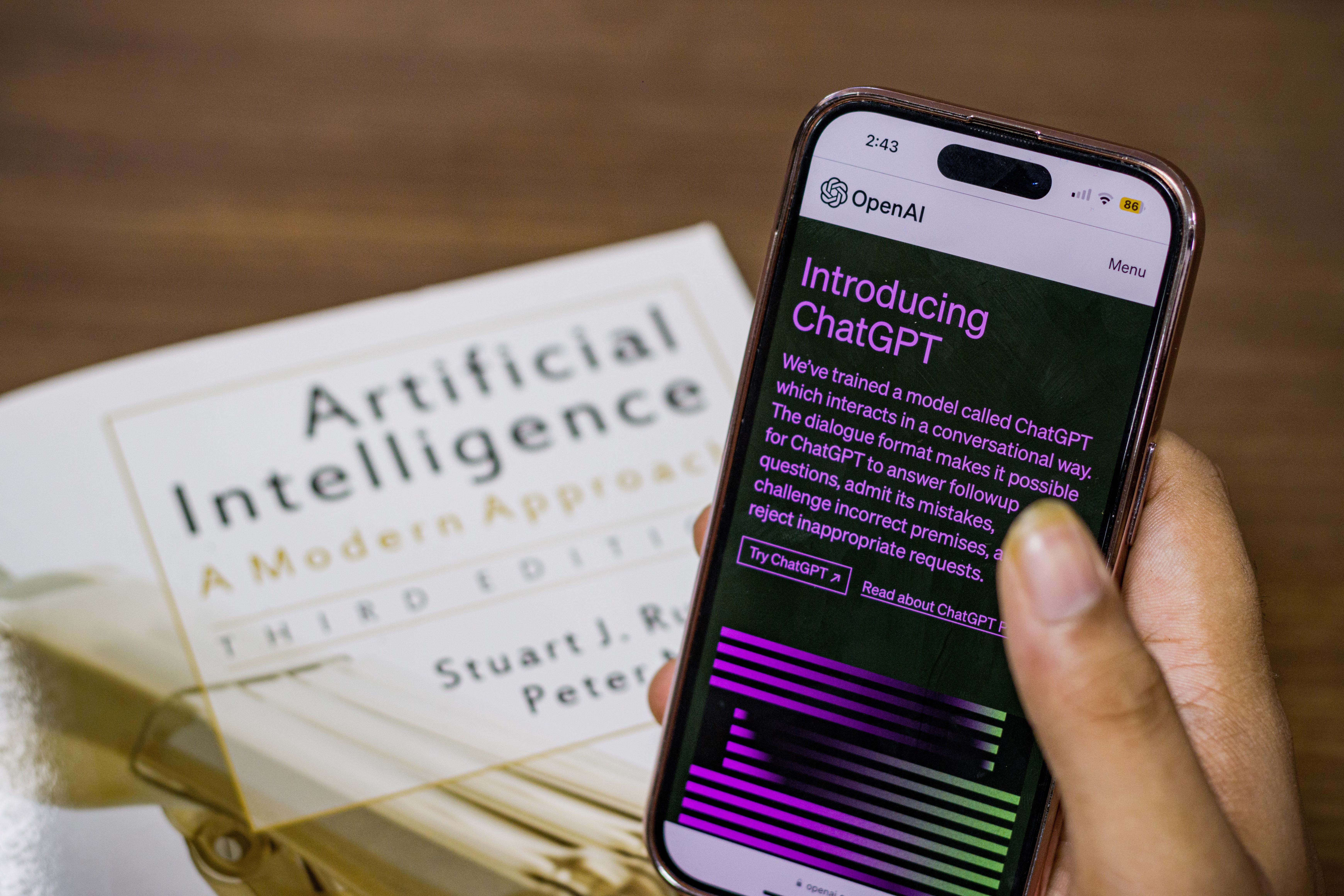
OpenAI has rolled out an advanced Voice Mode for its artificial intelligence chatbot, ChatGPT, enabling users to speak and listen to the system with minimal latency and natural conversational flow. The updated feature allows the application to process spoken inputs directly without converting them first to text, resulting in real-time responses that mimic human dialogue cadence, interruptions, and emotional expressions.
WHO ARE THE KEY PLAYERS
OpenAI, an American artificial intelligence research organization headquartered in San Francisco, California, which developed and maintains the ChatGPT platform.
UNDERSTANDING THE LOCATION
San Francisco, California, located on the West Coast of the United States, serves as the global technology hub where major software developments and generative artificial intelligence breakthroughs originate before being deployed worldwide via internet infrastructure.
BACKGROUND AND CONTEXT
Early digital voice assistants introduced a decade ago relied on rigid keyword recognition, often requiring users to speak in staccato bursts and wait for slow cloud processing. Over the years, machine learning models improved transcription accuracy, but conversations remained transactional rather than fluid. The transition to end-to-end audio neural networks represents a paradigm shift in human-computer interaction, bypassing traditional text conversion steps to process audio signals natively.
EXPLAINING IMPORTANT REFERENCES
Generative artificial intelligence refers to computer algorithms capable of generating text, audio, images, or video in response to prompts. Latency is the technical term for the delay between a user's action and a system's response; in this context, lowering latency means the artificial intelligence replies almost instantly, just like a person on a phone call.
IMPACT ANALYSIS
This technological advancement lowers barriers for individuals who find typing cumbersome or who prefer auditory learning methods, expanding accessibility across education and professional productivity sectors. However, increased realism in synthetic voices raises valid concerns regarding impersonation, digital deception, and the psychological impact of forming emotional attachments to software programs.
WHAT HAPPENS NEXT
As computing infrastructure scales, developers plan to roll out expanded audio capabilities to enterprise clients and mobile applications globally, while policymakers debate regulatory frameworks to govern synthetic media and voice cloning technologies.
HERO PERSPECTIVE
OpenAI deployed the updated Voice Mode via the ChatGPT mobile application for supported iOS and Android devices running version 2024 or later. Users can activate the feature by tapping the voice icon within the chat interface to initiate a direct spoken session.
CLOSING
As voice-first computing matures, the boundary between human communication and machine interaction continues to blur, demanding both technological innovation and careful societal oversight.